
What are the risk alerts for?
The Risk Alerts function in GrowPilot highlights potential future risks in climate extremes that can have an impact on crops, growing infrastructure and the operational activities of a farm.
Where can I find the risk alerts?
Home Dashboard
A summary of the risk alerts are found on the Home dashboard (bottom left tab of the app) in two places;
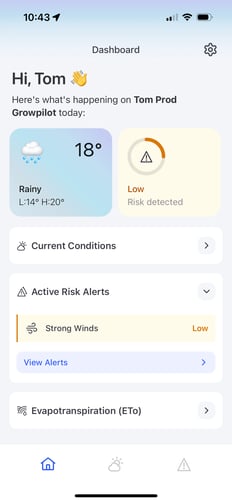
1. In the “Active Risk Alerts” section, click on the drop down button to see the risks.

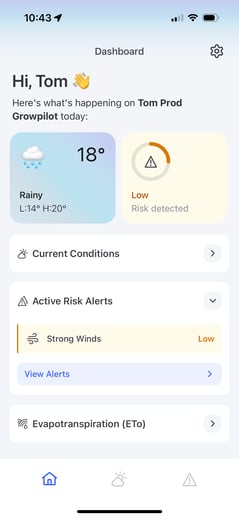
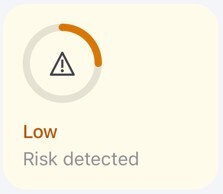
2. In the risk alerts summary widget.
Risk Alerts
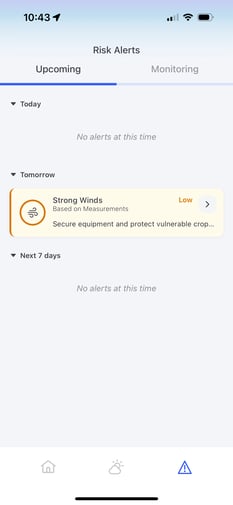
For more details of the risk alerts, click in these areas outlined above or on the Risk Alerts tab (bottom right tab of the app).
The “Upcoming” tab shows the risks for today, tomorrow and the next 7 days.
The “Monitoring” tab shows all of the risks that are currently being monitored:
How often are the risk alerts generated?
The system scans for risks multiple times a day and generates an alert in the GrowPilot app accordingly.
What risk alerts are available?
Plant Stress
|
What is Plant Stress? |
Plant stress occurs when the demand placed on a plant by its environment exceeds its ability to cope using its normal regulatory mechanisms. In GrowPilot, plant stress is defined by having a high Vapor Pressure Deficit (VPD). VPD, is the difference (deficit) between the amount of moisture in the air and how much moisture the air can hold when it is saturated. High VPD causes plant stress because it increases evaporative demand beyond what the plant can sustain, leading to water loss, overheating, and reduced photosynthesis. When vapour pressure deficit (VPD) is high, the air pulls water from leaves faster than roots can replace it, forcing stomata to close and reducing growth and self-cooling. This risks heat stress, wilt, and poor fruit set. |
|
What is the alerting criteria? |
Moderate - VPD of 1.8–2.2 kPa for more than 2 hours and the air temperature exceeds 20°C during the day High - VPD of 2.2–2.5 kPa for more than 3 hours and the air temperature exceeds 20°C during the day Severe - VPD exceeds 2.5kPa for more than 4 hours and the air temperature exceeds 20°C during the day |
High Winds
|
What is High Winds? |
High winds refers to strong, sustained air movement. High winds can cause significant damage to the plant, the fruit and growing infrastructure. Strong winds cause physical damage (lodging, breakage) and rapidly dry out crops, increasing water stress. They also tear infrastructure like covers/netting and create dangerous spray drift. In the event of high winds, secure all structures and postpone spray applications until conditions are calm. |
|
What is the alerting criteria? |
Moderate - Average winds of 25-40 km/hr OR gusts of 50-70km/hr for more than 2 hours Strong - Average winds of 40-60km/hr OR gusts of 70-90km/hr for more than 2 hours Damaging - Average winds exceeding 60km/hr OR gusts exceeding 90km/hr for more than 2 hours |
Heavy Rainfall
|
What is Heavy Rainfall? |
Heavy rainfall refers to a high amount of precipitation over a limited timeframe. Heavy rainfall can cause damage to the plants and damage fruits. Heavy rain saturates soil, suffocating roots and causing erosion and nutrient loss. These wet conditions spread fungal diseases and limit field access. In the event of heavy rainfall, monitor drainage in low spots and delay all fieldwork, spraying, and harvest until the ground can support machinery. |
|
What is the alerting criteria? |
Moderate - 20-30mm in 24 hours OR 30-50mm in 48 hours Heavy- 30-50mm in 24 hours OR 50-80mm in 48 hours Flooding conditions - exceeds 50mm in 24 hours OR exceeds 80mm in 48 hours |
|
What is Frost? |
Frost is a deposit of soft white ice crystals or frozen dew drops on the plant surface. Frost can damage crops and lead to substantial losses. Some crops are more susceptible to frost than others and it is important to closely monitor weather forecasts and implement protective measure such as using frost fans or overhead irrigation to mitigate potential impacts. Please be aware that even with low frost risk, crops can still freeze at very low temperatures. |
|
What is the alerting criteria? |
Light – Minimum temperature < 2 °C with either clear skies or < 10km/h wind Moderate - Minimum temperature 0–1 °C with clear skies & wind <10 OR (Advection) min ≤0 °C with wind 10–25 km/h Heavy - Minimum temperature ≤–2 °C with clear skies & wind <10 OR (Advection) min ≤0 °C with wind ≥25 km/h |
|
What is Botrytis? |
Botrytis, also known as grey mould, is a fungal disease that affects many plant species, thriving in high humidity. Botrytis can cause soft, watery rots, wilting and blight in multiple plant tissues including the fruit, flower, stem and buds. It can cause significant loss to crops and post-production fruits. Reduce relative humidity immediately, dry the crops or apply preventative fungicides.
|
|
| What is the alerting criteria? |
Low Botrytis Risk Medium Botrytis Risk High Botrytis Risk |
Low, Medium or High depending on duration and temperature of conditions |
|
What is Powdery Midew? |
Powdery mildew is a common fungal disease that appears as white, powdery spots on plant leaves, stems, and flowers, thriving in warm, humid conditions and spreading via spores. It weakens plants by blocking sunlight, but can be managed with good air circulation, proper watering (avoiding foliage), and organic treatments like horticultural oils or fungicides |
|
What is the alerting criteria? |
Low Powdery Mildew Risk - Average hourly temperature is between 15°C-25°C for 6 consecutive hours in one of the 3 consecutive days Medium Powdery Mildew Risk- Average hourly temperature is between 15°C-25°C for 6 consecutive hours in two of the 3 consecutive days High Powdery Mildew Risk- Average hourly temperature is between 15°C-25°C for 6 consecutive hours in three of the 3 consecutive days |